
Agentic AI in Recruitment: Balancing with AI & Human Hiring
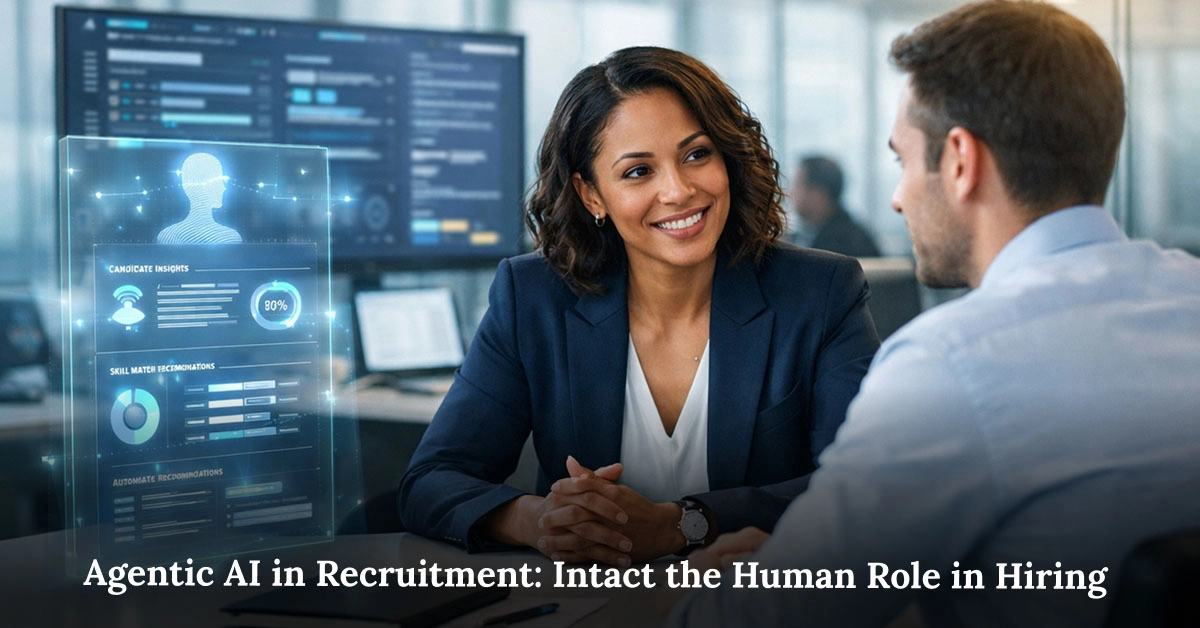
The real issue with top recruitment or HR leaders today is not about how AI is transforming HR processes but whether their down team will effectively use AI for removing the human bias, winning candidate trust and succeed to gain fantastic outcomes of using AI hiring model. Agentic AI in recruitment is useful for great hiring decisions.
Across the recruitment industry, Certain trends are coming up. One is to make it fast to deploy agentic AI across their workflows to handle huge work. The other one is doubtful that automation will dilute human judgment, biased hiring outcomes, or lower down candidate experience.
This is not an uneven picture. It’s the design bottleneck of modern recruitment.
The toughest hiring teams aren’t selecting between AI and humans. They’re designing for an intended human-AI partnership, where each does in which it does best.
Understand How Agentic AI in Recruitment is Reshaping Hiring
Support smart decisions with a balanced AI hiring model
The Strengths and Practical Limits of Agentic AI
Agentic AI refers to systems those perceiving information, make decisions, and act with minimal human interference. In recruitment, its strong points are clear.
Tasks that once utilised full recruiting teams i.e. resume screening, interview scheduling, candidate reminding alerts, status updates – can now be done faster, more regularly, and at high volume.
Screening hundreds of resumes verses structured criteria- this task is done by AI in some minutes.
Interviewer’s availability is checked and scheduled across calendar by AI.
Basic criteria matching across various candidates to schedule their first level interview is tirelessly done by AI.
These abilities are not enough, as bulk table duties to be automated for high-volume and enterprise hiring.
Where organizations juggle is assuming that each hiring decision should be treated in the same way.
The Three Tiers of Hiring Decisions
Not every hiring decision carries the same level of risk or responsibility. Still in various organizations, each step in the recruitment process is catered with the same level of attention. This mostly makes unrequired stress on recruiters and slows down the entire hiring process.
The reality is simple. Certain decisions in recruiting are regular while others need experience, context, and concerned judgment. When companies fail to identify this difference, technology is underutilised or applied in the wrong areas.
AI works well when it supports correct tasks rather than trying to organise each part of recruitment.
It is preferable to divide hiring decisions into 3 tiers based on complexity and impact.
Tier 1: Operational Decisions by AI

The first tier has operational decisions. These are the daily tasks that keep the recruitment process moving but do not require deep analysis or human interpretation.
They follow transparent rules and usually involve straightforward checks.
For example:
- Does the candidate’s resume add the expected skills or certifications?
- Is the candidate available for the scheduled interview time?
- Have all compulsory documents or background checks been done?
- Does the application meet the basic eligibility criteria like experience level or job location?
These steps may sense smaller, but they consume large chunk of a recruiter’s time. Reviewing resumes, checking of candidate details, documents confirmation, and coordinating interview slots cover up a full workday.
As these tasks are necessary, they are very much administrative.
This is exactly where Agentic AI may offer the maximum value. AI systems may quickly review applications, verify requirements, manage candidate information, and schedule interviews automatically.
AI does the multiple hours consuming job by humans in some minutes.
When these operational activities are automated, recruiters mostly gain back 15 to 20 hours each week. This time is easily utilised for most important tasks interacting with candidates, knowing their motivations and evaluating how well they fit inside the team and company culture.
In this first tier, AI works well when it operates solely within clear guidelines. It acts as a trusted support system handling redundant tasks, keeps the hiring pool moving easily, and allows recruiters to focus on decisions really benefitting from human insight.
Tier 2: Analytical Decisions (AI-Driven, Human-Owned)

The second tier of hiring decisions is where technology and human judgment work jointly. These decisions are tougher over routine operational tasks, but they still give an edge- from structured data and insights. While AI can analyse information and highlight patterns, the ultimate judgment must be with recruiters or hiring managers.
At this stage, hiring is no more about simple checks. Rather, it includes candidates’ assessment more thoughtfully and comparing them in a meaningful way.
Recruiters start asking questions like:
- How does this candidate stand part from others applying for the same role?
- Does their working style align the environment and team expectations?
- Are there strengths or potential reasons that might not be obvious from a resume only?
These questions require context and interpretation. A resume may show skills and experience, but it cannot grab how a person collaborates, adapts, or addresses problems in real situations. This is the reason why human involvement is a must.
In this tier, AI acts as a support system than a decision-maker. Its role is to manage information, reveal useful patterns, and offer comparisons that will be helpful to the recruiters to see the big picture.
For example, AI can quickly analyse assessment results, notice candidate strengths, and identify ‘close matches’ with the requirements of the role.
This helps recruiters review candidates with clarity more and no guesswork. Instead of sorting via scattered data, they can focus on the insights.
Anyhow, the final evaluation still depends on people. Recruiters and hiring managers usually bring together many important elements before deciding.
These may include:
- Skills assessments, show the candidate’s technical abilities
- Behavioural indicators, which help understanding communication and work style
- Role benchmarks, which define the strong performance
- Team context, including culture, expectations, and the current team dynamics
By considering all these factors together, hiring teams can make a clear and more balanced view of each candidate.
When AI is used in this way, hiring becomes more planned and transparent. Decisions are no longer based only on instinct or first impressions. Rather, they are helped by managed insights and meaningful comparisons.
In easy words, Tier 2 is where AI the recruiter’s perspective. It enables clarity to tedious information, while humans use experience, judgment, and awareness to make the final call.
Tier 3: Strategic Decisions (Human-Led)

These decisions design your organization:
Is this a durable leadership hire?
Should we trade experience for diversification or growth potential?
Is this candidate worth to wait for?
These are value-driven decisions including culture, strategy, and future impact. AI can offer data, but humans must lead.
Organizations automating Tier 3 decisions much aggressively mostly see:
- Reduce offer acceptance
- Poor early retention
- Damaged employer brand
The framework matters because misplacing automation is costlier than not using AI at all.
Why This Moment Matters for HR Teams?
By 2026, competitive edge in hiring would not come from “having AI.”
It will come from AI expert’s teams.
The recruiter role is already transforming – from administrative coordinator to talent strategist. AI excels this changeover, but only if teams are equipped to manage it.
That means recruiters should:
- Interpret AI-generated insights
- Challenge scores when context demands it
- Build relationships AI cannot
- Act like advisors to hiring managers
This changeover is unpleasant. It’s also unavoidable.
Make a Best Hiring Process with Agentic AI in Recruitment
Use a smart AI hiring model for your business
How to Make a Strong Human–AI Hiring Model
Let us see here how to compose a Human and AI hiring model step by step:
1. Audit Your Hiring Workflow
Map each step of your recruitment process. Classify every decision into Tier 1, 2, or 3. Most organizations find that only 30–35% of their workflow should be fully automated. The remaining needs thoughtful augmentation.
2. Automation of the Right Work
Use agentic AI rigorously for Tier 1 tasks:
- Resume parsing & Screening
- Scheduling and reminding alerts
- Status communication
This isn’t about speed only – it is about freeing cognitive capacity.
3. Augment Human Judgment with Better Intelligence
The biggest benefits come when AI supports Tier 2 decisions.
Modern hiring teams benefit from:
- Skills-based matching instead of keyword screening
- Behavioural analysis from video interviews
- Comparative benchmarking across similar candidates
- Predictive indicators tied to role success
When insights develop within recruiter workflows, then quality of decision improves drastically.
4. Protect Space for Human Connection
This is not a soft benefit. It’s a strategic one.
When recruiters aren’t burdened by coordination and admin work, they can:
- Make authentic candidate relationships
- Tell persuasive employer stories
- Direct hiring managers via subtle decisions
- Intellectually inclined negotiations with top talent
AI does not eliminate the human touch – it retains space for it.
5. The Assessment Integrity Challenge
As AI becomes more accessible to candidates, assessment integrity becomes hard and more important.
Traditional methods are increasingly fragile due to:
- Open-ended questions may be AI-assisted in real time
- Knowledge tests can be easily managed
The solution is not for the ban to AI or AI hiring model. It’s all about the designing of assessments those identifying real capability:
- Scenario-based problem solving
- Role-driven work samples
- Designed behavioural interviews
- Video-based assessments capturing consistency and engagement over time
Latest platforms now analyse behavioural signals in interviews – flagging anomalies without restricting genuine candidates. Such right acts help improving fairness in the interview processes.
6. Organizational Shift
Deploying agentic AI in recruitment is not an instant-kickstarting project.
It’s a redesign of how hiring decisions are made.
Successful organizations are fair on:
- Which decisions AI owns vs supports vs informs?
- What success parameters matter other than speed?
- How recruiter roles changeovers?
- How fairness, explainability, and trust are retained?
They invest in enablement – not only technology.
What is Niyuk’s Role in Agentic AI in Recruitment?
Niyuk contributes to the evolution of agentic AI in recruitment by helping organisations intelligent automation with human decision-making. Rather than replacing recruiters, the platform is made to support a modern AI hiring model where technology assists the process under the human control.
Niyuk helps automate early hiring activities like resume screening, application sorting, and initial candidate shortlisting. By analysis of candidate profiles and identifying relevant skills and experience, the system highlights applicants who are ‘close match’ to the job requirements.
This lower down human workload and permits recruiters to focus on the most suitable candidates at the earliest.
While the platform gives useful insights guiding recruiters in spite of making decisions for them. Interviews, cultural fit check, and final hiring choices still rely on human judgment. This balance keeps the hiring process intelligent, and context driven.
In practice, Niyuk supports agentic AI in recruitment by empowering the AI hiring model with intelligent assistance. Routine tasks become fast and more organised, while recruiters remain responsible for assessing talent and making the final call.
Transform your Hiring with Agentic AI in Recruitment
Leverage a modern AI hiring model
Conclusion
The recruitment future lies in partnership and not in the replacement. The companies leading in the talent marketplace not necessarily the loudest AI claims.
They will be those who remove recruiter busy tasks, boost up decision quality, not only speed. They implement trustworthy interview processes and experience for the candidates. They will intact the moments where human judgment is highly required.
The future of recruitment is not AI against humans. It’s humans with AI – making recruitment processes fast and done with better decisions, to build relationships and culture. Efficiency with durable advantages is the exact role of Agentic AI in Recruitment today.
For more enquires and requirements, drop an email to us on: sales@devniyuk.winayak.com
Frequently Asked Questions
1. What is agentic AI in recruitment?
Agentic AI in recruitment refers to autonomous, goal-driven AI systems managing end-to-end hiring processes – sourcing, screening, interview scheduling without constant human supervision.
2. How does agentic AI differ from traditional AI or automation?
Agentic AI differs from regular AI and automation by functioning with autonomy, using “observe-think-act” loops to set goals and adapt to changing conditions over following the rigid, pre-programmed scripts.
3. Does agentic AI replace human recruiters?
Agentic AI does not replace human recruiters but changeovers their role from administrative, task-driven work to strategic, relationship-focused talent acquisition. By automating up to 80% of repetitive tasks like screening, scheduling, and sourcing, these agents enable recruiters to focus on candidate experience, tougher judgment, and hiring strategy.